
Every year, the employer branding calendar gets more crowded. Between HR technology expos, recruitment festivals, awards ceremonies and dedicated employer branding conferences, a Talent Acquisition Manager or Employer Branding lead can find a reason to travel almost every month.
The problem is not a shortage of events. The problem is that most of them were not designed with the same team, the same maturity stage or the same outcome in mind.
This guide sets out a practical framework for evaluating employer branding conferences before you register – what to look at beyond the agenda, how to read a sponsorship pack, and how to decide whether an event is built for people who set employer branding strategy or for people who attend it as a side note to a broader HR tech agenda.
Why the same conference isn’t right for every HR team
A conference built for developers who happen to be hiring is a different from a conference built for people whose job is employer branding and talent attraction.
We Are Developers in Berlin, for example, is a technology-first event where recruitment is one of several threads.
HR Tech Europe in Amsterdam is built around software and platforms.
Neither is wrong for a Talent Acquisition function with a technology hiring problem, but neither is designed to teach a Marketing or Comms Director how to build an EVP, structure an employer branding budget, or benchmark against peers in the same market.
This distinction matters because travel budgets, certification hours and time away from the desk are finite.
The real cost of picking the wrong event
The visible cost of a conference is the ticket price. The real cost is what happens after the event, when the delegate is asked to justify the trip. If the sessions attended do not translate into a framework, a benchmark or a concrete next step for the team back home, the conference becomes a line item that is harder to defend the following year.
This is precisely the hesitation that HR Managers and Directors of People raise internally: “we already went to a conference this year – what changed?”
Choosing well, in other words, is not about attending more events. It is about attending the right one for the stage the team is in, and coming back with something actionable.
Six criteria to evaluate before you book
1. Audience quality and job titles in the room
Before checking the agenda, check who else is registered. An event with 300 attendees where the majority are Talent Acquisition Managers, Employer Branding leads and People Directors will generate more relevant conversations in the coffee break than an event with 3,000 attendees spread across recruitment, HR tech, payroll and general people operations.
Ask the organiser directly for a breakdown of job titles from the previous edition – a serious event will have this data ready.
2. Content applicability to your maturity stage
A guide to building an EVP from scratch is of little use to a team that already has one and is now trying to measure its impact.
Look at whether the agenda separates content by maturity level – foundational sessions for teams starting out, and case-study-driven sessions for teams optimising an existing strategy. This is one of the clearest signals of how well an event understands its own audience.
3. Networking structure, not just headcount
A large attendee count is meaningless if the format does not create structured opportunities to meet the right peers.
Look for dedicated networking slots, matched introductions, or smaller workshop-format days ahead of the main conference – a structure increasingly common across European employer branding and recruitment events, from smaller regional meetups to larger two-day formats that separate a workshop day from a conference day.
4. Speaker lineup and case study depth
A stage full of consultants presenting theory is different from a stage where in-house Employer Branding leads present real numbers – conversion rates, cost-per-hire, application volume, retention impact.
Before registering, check whether the previous edition’s speaker list is public, and whether it names companies and job titles, not just first names. Depth of case study is a strong indicator of whether the content will be usable on Monday morning.
5. Certification and measurable ROI for your team
Increasingly, employer branding events issue certification hours that can be logged for professional development, a detail that matters when a People Director is deciding which trip to approve.
Ask specifically how many certified hours the event offers, through which platform, and whether attending a workshop day and a conference day are certified separately or combined.
6. Format: single-day vs multi-day, workshop vs conference-only
A single-day conference is efficient but leaves no room for hands-on workshop time.
A two-day format that dedicates day one to workshops and day two to the main conference – the structure adopted by the Employer Branding Conference in Lisbon – allows a team to bring back both a practical framework from the workshops and a set of case studies and benchmarks from the main stage, without needing to choose between the two.
Comparing the global landscape of employer branding events
The table below maps some of the main employer branding, talent attraction and HR technology events across Europe and the US, based on publicly available scheduling data. It is a starting point for benchmarking format and scale, not a ranking, since the right fit depends on the six criteria above and on your team’s own priorities.
Employer branding and HR conferences across Europe and the US — indicative 2026/27 schedule
| Event | Location | Typical timing | Format focus |
|---|---|---|---|
| Employer Branding Conference | Lisbon | February | Employer branding & talent attraction, workshop day + conference day |
| Employer Branding Forum | Helsinki | February | Employer branding, Nordic market |
| HR Tech Europe | Amsterdam | April | HR technology & platforms |
| HRCorelab | Barcelona | March | HR strategy & operations |
| EBCon | Bucharest | May | Employer branding, CEE market |
| Future Talent Summit | Stockholm | June | Talent acquisition & workforce trends |
| Rec Fest (UK & US editions) | Knebworth / Nashville | July & September | Recruitment, large-scale festival format |
| Happiness Camp | Porto | September | Employee experience & wellbeing |
| HR Week (Lisbon & Barcelona editions) | Lisbon / Barcelona | April & November | General HR, multi-track |
| Talent Acquisition Week | San Diego | February | Talent acquisition, US market |
Two patterns stand out.
👉 First, most large HR technology events are built around platforms and software categories rather than around employer branding as a discipline in its own right – useful for a Talent Acquisition Manager evaluating tools, less useful for someone building an EVP.
👉 Second, employer branding-specific events remain regional: a Helsinki-based or Bucharest-based conference will speak primarily to that market’s employers, benchmarks and case studies. For a team hiring in or communicating to the Portuguese and Southern European market specifically, an event rooted in that market carries more directly applicable case studies than a conference built for the Nordics or Central Europe.
Where the Employer Branding Conference fits in this landscape
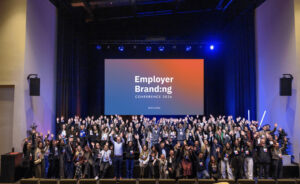
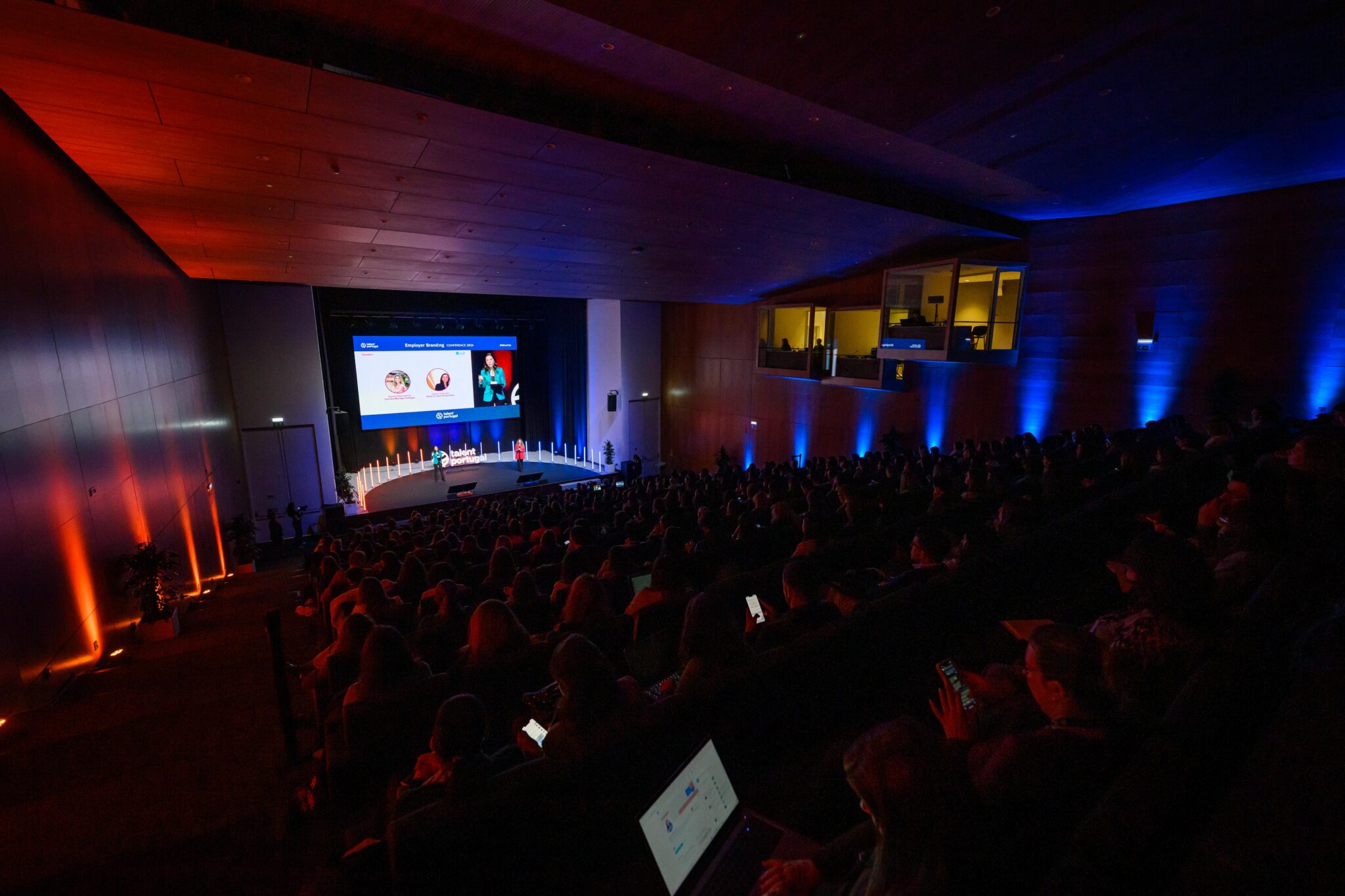
The Employer Branding Conference, is built specifically around the six criteria above. Since its first edition in 2017 it has consistently brought together more than 300 attendees, over 100 companies and more than 30 speakers per edition, positioning it among the largest dedicated employer branding gatherings in Portugal.
👉 The 2027 edition is scheduled for 1 and 2 February, in Lisbon.
The first day is dedicated to workshops, delivered in masterclass format; the second day is dedicated to the main conference stage. Attendees who take part in both days can obtain 16 hours of certification, or 8 hours for the conference day alone, issued through the Certifier platform, a detail worth checking against your own team’s professional development requirements before registering.
For teams evaluating the event against a peer’s Great Employers page or a competitor’s employer brand, the Great Employers platform gives a direct sense of the kind of company profiles and EVP storytelling the conference community works with year-round, ahead of the event itself.
Teams building foundational EVP knowledge before attending can also start with the certified Employer Branding course, developed in partnership with Universum Global, or review the broader employer branding resources for organisations available on the platform.
A short checklist before you register
- 1. Does the organiser share the previous edition’s attendee job titles, not just headcount?
- 2. Is the agenda split by maturity level, or is it a single generic track?
- 3. Does the format include structured networking, or only a general break between sessions?
- 4. Are named companies and job titles listed as speakers, with case studies rather than theory?
- 5. Does the event issue certified hours, and through which platform?
- 6. Does the format separate a workshop day from a conference day, or compress everything into a single track?
So, which conference deserves your team’s budget?
If your team is weighing this year’s employer branding conference budget, the fastest way to compare is to look at the Employer Branding Conference agenda directly, including speaker announcements, sponsorship tiers and ticket options.