

Companies should measure employer branding through three connected layers: awareness (how visible the employer brand is), conversion (how that visibility turns into applications and hires), and retention (whether the people who join actually stay and advocate for the company). Most organisations stop at layer one.
A banner, a careers page redesign or a well-produced testimonial video can generate likes and shares, but if nobody in the room can say what happened to quality of hire, time-to-fill or retention six months later, employer branding stays a “nice to have” line item rather than a business function with a number attached to it.
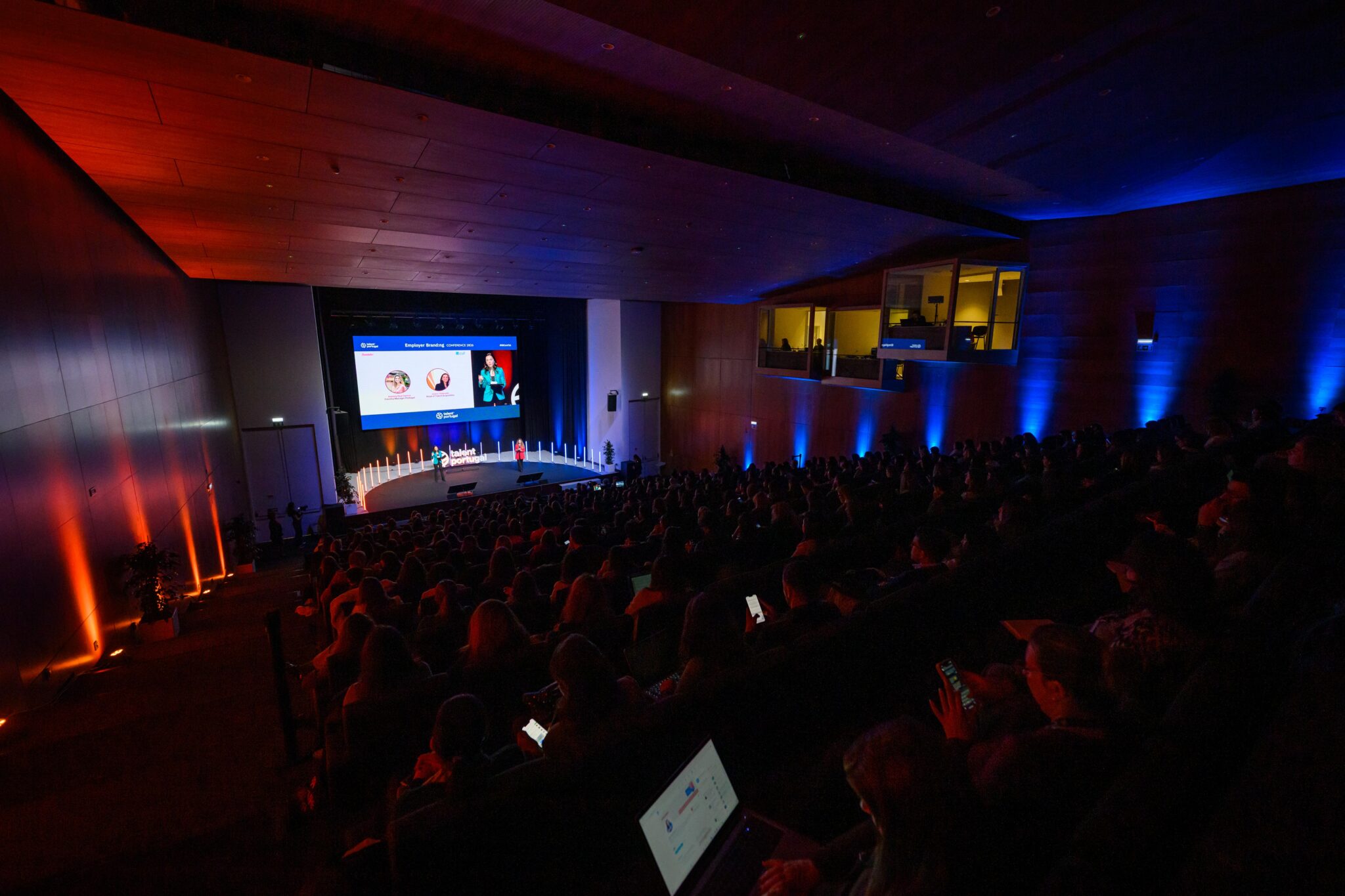
This is the exact conversation Talent Portugal has every year with the companies present in Great Employers and with the HR and talent acquisition leaders who attend the Employer Branding Conference.
👉 The pattern is consistent: teams that treat employer branding as a measurable system outperform teams that treat it as a communication exercise.
What are the core employer branding metrics worth tracking?
The core metrics fall into four groups: awareness (reach, branded search volume, share of voice), conversion (application rate, application quality, conversion to interview), experience and retention (candidate experience scores, quality of hire, retention rate, employee referrals), and advocacy (reviews, employee-generated content, internal referral volume).
Each group answers a different question.
1. Awareness tells you whether the right people know the company exists.
2. Conversion tells you whether that awareness is producing usable candidates.
3. Retention tells you whether the promise made during recruitment was actually kept.
4. Advocacy tells you whether current employees are willing to put their name behind that promise in public.
Treating these four groups as one single “employer branding score” is where most measurement efforts collapse – a strong awareness number can hide a weak conversion number, and a decent conversion number can hide a retention problem that only shows up a year later.
How does an employer branding measurement system actually work in practice?
A working system starts with a baseline, assigns one owner per metric group, and reviews the numbers on the same cadence as any other business KPI, usually quarterly, tied to hiring plans rather than to marketing campaigns.
In practice, this means awareness metrics sit with communication or marketing, conversion and quality of hire sit with talent acquisition, and retention and advocacy sit with HR business partners, but all four groups report into the same dashboard.
Companies that separate these numbers into different tools and different owners, without a shared dashboard, consistently struggle to prove that employer branding activity connects to business outcomes.
The employer branding case studies shared each year at the Employer Branding Conference show the same pattern: the companies with the clearest ROI story are the ones that built this shared dashboard before they built the campaign.
What doesn’t work and why?
Three measurement habits show up repeatedly among companies that struggle to defend their employer branding budget:
- Measuring reach without measuring quality. Impressions and followers grow, but nobody checks whether the candidates arriving through those channels are the profiles the company actually needs. Awareness without a conversion metric attached is a vanity number.
- Treating employer branding as a one-off campaign. A video, a press release or a conference sponsorship gets a spike in traffic, then the measurement stops until the next campaign. Without a continuous baseline, there is no way to isolate what caused a change in application quality or retention.
- Ignoring the employee side of the data. Candidate experience surveys exist, but exit interviews, internal referral rates and trends are tracked separately, if at all. Advocacy is the metric that proves whether the employer brand matches reality and it is the one companies most often skip.
Which metric should a company prioritise first?
For most organisations, quality of hire and candidate experience should come before awareness metrics, because a strong reputation built on a poor candidate journey erodes faster than it was built. Fixing the experience layer protects every other number.
This is precisely why the annual Employer Branding Report produced by Talent Portugal with more than 230 professionals contributing to its first edition focuses on structured, comparable data rather than isolated campaign metrics: it lets HR and talent acquisition leaders see where their own numbers sit against the rest of the Portuguese market before deciding where to invest next.
How should HR and talent acquisition teams put this into practice?
Whether the priority is talent acquisition, employer branding or people leadership, the practical next step is the same: agree on the four metric groups internally, assign one owner to each, and put them on a single dashboard before running the next campaign. Teams that skip this step end up measuring activity, not impact.
Employer branding metrics only matter if they are compared against something.
A company’s own historical numbers are a starting point, but the real test is how those numbers compare to the rest of the market and that comparison is exactly what structured, sector-wide data makes possible.
Access the full Employer Branding Report from Talent Portugal and see how your awareness, conversion, retention and advocacy metrics compare to the Portuguese market with data contributed by more than 230 HR and talent acquisition professionals.